Archive for September, 2011

Should Yoga Practitioners Establish Goals?

Friday, September 30th, 2011

online yoga courseBy Gopi Rao

There is a school of thought, within Yogic circles, which discourages the establishment of goals. You may have heard that Yoga teachers shouldn’t accept money, students shouldn’t compete, and you shouldn’t compare yourself to others. While this is all well and good, this is the 21st century and living a life of being unattached to outcome is likely to get you fired from your job.

People do Yoga for all different reasons. Some people practice to get into shape, others do it to help eliminate stress. In regards to the question “Should Yoga practitioners establish goals?” the answer is often yes. Setting goals in Yoga can improve a person’s journey by keeping them focused. Achieving the goals can add to the sense of enjoyment that practicing Yoga brings. It can also help a person strive to evolve and reach higher goals as their practice evolves. Setting goals help to give purpose to the practice of Yoga.

Let’s just say for the sake of argument that someone starts Yoga to get into better shape. For many people, that goal means losing extra weight or inches around certain problems areas, including the waist. Some people may achieve this through Bikram Yoga or Hot Yoga classes. Bikram Yoga is a fascinating practice of Yoga that is done in a room set at a specific temperature (105 degrees and 40% humidity). The workout is two hours long and very intense. Hot Yoga is a little different than Bikram, with the differences being in room temperature and the number of poses. However, both of them encourage the body to sweat, which in turn can release water weight and toxins.

Of course, that doesn’t mean practitioners have to always rely on intense Yoga sessions in order to garner results. Another type of Yoga, called Hatha, is often good for stretching the body, establishing strength and gaining flexibility. It also uses meditation as a tool to help clear the mind and eliminate stress. All of those are common goals in Yoga practice as well. Establishing goals in life is common practice and setting goals within Yoga practice is certainly not unusual.

Yoga is also practiced just for the sheer enjoyment of it. It certainly is not always used as a means to an end, but knowing that it can be used to attain goals is certainly a positive aspect. For many people, the practice of Yoga is a way of life and can be a way for them to maintain harmony and balance within themselves.

© Copyright 2011 – Aura Wellness Center – Publications Division

To see our selection of Online Yoga teacher training courses, please visit the following link.

http://www.aurawellnesscenter.com/store/

FREE Yoga Report. FREE Yoga Newsletter. FREE Yoga Videos. Free Podcasts. Bonus: Free Yoga e-Book, “Yoga in Practice.”

FREE CONTENT: If you are a Yoga Teacher, Yoga studio, blogger, e-zine, or website publisher, and are in need of quality content, please feel free to use my blog entries (articles). Please be sure to reprint each article, as is, including the resource box above. Namaste!

Yoga Precautions for Rheumatoid Arthritis

Thursday, September 29th, 2011

yoga teacher trainingBy Faye Martins 

Yoga teachers know that pre-existing physical conditions are important when teaching students. This is covered in a basic 200-hour yoga teacher training. Yet, there are a few new students who may manage to slip by an orientation. Maybe they arrive late, or the staff is helping other new students, but each student should be made aware of precautions for his or her health. Rheumatoid arthritis is one of the many ailments that Yoga teachers and students should talk about before practice.

A long-term disease leading to inflammation of the joints and tissues, rheumatoid arthritis (RA) can also affect other organs. Up to 1% of the world’s population is estimated to suffer from rheumatoid arthritis, with women experiencing it three times more often than men. Chronic and debilitating, those with RA may eventually require surgery to maintain movement in fingers, hands and other areas.

Can Yoga help those with RA maintain an active lifestyle? Some studies indicates yes: a study in the United Arab Emirates showed that patients who completed 12 sessions of Raj yoga, with exercise and breathing techniques, showed significant improvements in disease activity scores and health assessments. In 1994, the British Journal of Rheumatology published a study showing arthritis symptoms improving for patients who practiced Yoga and the Rheumatic Diseases Clinics of North America published two studies detailing joint stiffness and pain relief for Yoga practitioners in 2002.

Yet, even though Yoga may offer significant relief for RA, its practice should be approached with caution. The disease does not follow a steady, progressive course; instead, sufferers experience flare-ups followed by remission. Yoga practice suitable for someone in remission may be different from someone experiencing an active flare-up. RA affects joints symmetrically, in wrists, elbows, hands, shoulders, knees, feet and ankles most frequently. As the disease progresses, joints become more unstable and the patient’s range of motion is restricted.

It is important not to confuse asanas recommended for those with osteoarthritis and those with RA. Multiple joints are not affected in osteoarthritis, nor does it entail ongoing joint damage from inflammatory processes. Holding poses for increased lengths of time to strengthen static muscles is recommended for osteoarthritis but should be avoided for RA. According to a structural Yoga therapy research paper published in 2006, people with moderate to severe RA should avoid “high intensity exercise; prolonged weight-bearing exercise; prolonged immobility in seated or lying positions and stretching past the comfortable endpoint of range of motion,” among other lifestyle triggers.

Asanas involving pressure on the neck should be avoided, while poses like Dandasana or the Butterfly may be beneficial. Pranayama and smooth motions are well suited to Yoga practitioners with RA. Carefully evaluate whether symptoms are in remission or actively inflamed before practice.

© Copyright 2011 – Aura Wellness Center – Publications Division

To see our selection of Online Yoga teacher training courses, please visit the following link.

http://www.aurawellnesscenter.com/store/

FREE Yoga Report. FREE Yoga Newsletter. FREE Yoga Videos. Free Podcasts. Bonus: Free Yoga e-Book, “Yoga in Practice.”

FREE CONTENT: If you are a Yoga Teacher, Yoga studio, blogger, e-zine, or website publisher, and are in need of quality content, please feel free to use my blog entries (articles). Please be sure to reprint each article, as is, including the resource box above. Namaste!

The Good and Bad of Bhastrika Pranayama

Wednesday, September 28th, 2011

yoga certificationBy Faye Martins 

Bhastrika Pranayama literally means “bellows breath”: exhaling quickly and forcefully, making a sound like air expelling from a bellows. Performing Bhastrika Pranayama regularly can provide health benefits, but how is it done and are there any contraindications?

“Bellows breathing” is performed in a relaxed sitting position, like Padmasana or Crossed Leg position. Inhale fully, inflating the chest, rather than the abdomen. When the lungs are completely fully, exhale forcefully. The air should make a hissing sound as it escapes. The breathing should be repeated five to ten times, as forcefully and quickly as possible; stop if you start to feel dizzy or faint. When you have finished one “round” of breathing, take a deep inhalation and hold the breath in as long as possible. Exhale when needed and then take several normal breaths; begin another set when you feel comfortable. Five minutes a day is the recommended time period for Bhastrika Pranayama.

When performed correctly, this breathing exercise helps provide the body with maximum oxygen, which makes the skin glow. Other benefits include reducing toxins in the body, increasing warmth in the body and strengthening the immune system, and reducing respiratory tract ailments. Blood purification and weight loss are also benefits of “bellows breathing.” It is said that this is the secret to ageless skin and beauty!

Although there are many advantages to Bhastrika Pranayama, it is not for everyone. Practitioners with high blood pressure or cardiac problems should avoid this exercise. If the temperature is high, such as during the summer or in an overheated room, this kind of breathing should be limited to two minutes, rather than five. Continuing to breath deeply and forcefully when you feel faint may lead to hyperventilation, so it is important to stop immediately if dizziness occurs.

Hyperventilation decreases the carbon dioxide level in the blood and reduces blood flow to the brain, resulting in confusion and agitation. Calcium levels in the blood are also affected, leading to numbness and muscle twitching. In very rare cases, the blood vessel supplying the heart can spasm; if heart disease is already present, this could trigger a heart attack, which is why Bhastrika Pranayama must be avoided in those with the condition.

As with other asanas and practices in Yoga, it is important to remember that these are powerful tools, to be regarded respectfully. Take seriously any negative signs from your body or your students.

© Copyright 2011 – Aura Wellness Center – Publications Division

To see our selection of Online Yoga teacher training courses, please visit the following link.

http://www.aurawellnesscenter.com/store/

FREE Yoga Report. FREE Yoga Newsletter. FREE Yoga Videos. Free Podcasts. Bonus: Free Yoga e-Book, “Yoga in Practice.”

FREE CONTENT: If you are a Yoga Teacher, Yoga studio, blogger, e-zine, or website publisher, and are in need of quality content, please feel free to use my blog entries (articles). Please be sure to reprint each article, as is, including the resource box above. Namaste!


The Problem with Teaching Yoga Fitness Classes

Tuesday, September 27th, 2011

yoga certificationBy Sanjeev Patel, CYT 500 

“Whiz, zing, whoosh!” Those three little gibberish words sum up the pace of life these days. In fact, most people seem to be addicted to speed and things that work quickly always seem to win out – including high-energy, maximum-loss exercises classes.

In other words, if you’re a yoga instructor looking to engage students’ in both the physical and spiritual aspects of practice, you may have a tough time attracting students.

These Days, Speed Trumps Patience 

Our cultural commitment to efficiency has definitely led to valuable, groundbreaking discoveries; but it’s also made us less patient as a whole. Today, people expect results – pronto. And sometimes that “need for speed” presents a problem for yoga instructors. After all, working with fitness-minded students who don’t care about mindfulness and just want to keep slim can be frustrating.

Evangelizing On Behalf Of “Mom”

While hatha yoga is an exceptional form of exercise, you won’t see considerable weight loss in the first two months – a fact which many beginners find frustrating. After all, many of today’s “fad” diets, like Atkins and South Beach, boast of dramatic results within the first couple of weeks! And let’s not be coy, nowadays, in popular culture, the terms healthy and skinny – for better or worse – are nearly synonyms.

There’s also the issue of yoga’s sometimes-languid pace. Between spinning and step classes, kickboxing and Zumba, today’s exercise trends, just like our lifestyles, tend to be of the high-energy variety.

For the Yoginis out there: Remember when you were younger, and your mom wanted you to take ballet, but you really wanted to twirl it up in jazz? In many ways, yoga instructors are still fighting mom’s battle. So in a society that values the quickest route from A to B, it’s tough for constant reminders of mindfulness to compete with hip-hop music and rapid-weight-loss workouts.

More than ever, yoga has established itself as a standard in the exercise milieu. The job of introducing yoga to westerners is complete, and now it’s time for instructors to shape their personal teaching styles. Which way will you go? To keep up with the ever-increasing pace of life, will you focus on “power”  or fitness yoga styles? Or will you incorporate some of the more esoteric aspects of practice in the hopes of guiding students to a more mindful – and often slower paced – workout? The choice is yours; the only requirement is a genuine belief in your methods.

© Copyright 2011 – Sanjeev Patel / Aura Wellness Center – Publications Division

To see our selection of Online Yoga teacher training courses, please visit the following link.

http://www.aurawellnesscenter.com/store/

FREE Yoga Report. FREE Yoga Newsletter. FREE Yoga Videos. Free Podcasts. Bonus: Free Yoga e-Book, “Yoga in Practice.”

FREE CONTENT: If you are a Yoga Teacher, Yoga studio, blogger, e-zine, or website publisher, and are in need of quality content, please feel free to use my blog entries (articles). Please be sure to reprint each article, as is, including the resource box above. Namaste!


Heart Opening Yoga Poses

Monday, September 26th, 2011

yoga teacher certificationBy Gopi Rao 

The heart area can often become contracted and even caved-in due to difficult and painful life experiences. When the heart area is not expanded, cardiovascular circulation can be compromised, neck and back problems can develop and a sense of lethargy may predominate an individual’s emotional state. Yoga poses that open the heart area are great tools for releasing tension and difficult emotions. Heart-opening Yoga poses also help to lift a Yogi or Yogini’s mood, alleviate depression and bolster energy levels. Two classical heart-opening Yoga poses are Ustrasana or Camel Pose and Dhanurasana or Bow Pose. Before practicing these poses make sure that practicing several Sun Salutations warms up your body.

Ustrasana or Camel Pose 

Camel Pose is one of the most effective Yoga poses for opening up the heart area. Not only does Camel Pose expand the entire front side of the chest cavity, it also stimulates the thyroid and parathyroid glands, which promotes hormonal balance. Camel Pose also improves spinal flexibility.

To practice Camel Pose, start by kneeling on your mat. If your knees are sensitive, place a folded towel or blanket on your mat for added padding. Your knees should be approximately hip-width and your thighs perpendicular to your mat. Do not let your knees splay out, rotate your thighs towards each other and press the backs of your feet firmly against the mat for added support.

Place your hands on your sacrum, fingers pointing down towards your mat. Take one deep, full breath and with your exhale, slowly bend backwards until you reach your edge, which is the point where you feel a deep stretch but not pain. If you have any neck discomfort, keep your chin tucked into your chest. If your neck is not injured, and you are comfortable, you can drop your head back for an added throat and neck stretch. Hold the pose for three to five breaths. Repeat two more times. Release slowly as you come to an upright position. Rest for several minutes in extended Child’s Pose.

Dhanurasana or Bow Pose 

Performing Bow Pose is one of the most effective ways to open and expand the heart-area. In addition, Bow Pose increases spinal flexibility stretches the upper arms, back and neck areas and develops upper-body strength. Bow Poses also stimulates the digestive fire and relieves a variety of intestinal discomforts.

To perform Bow Pose start by resting face down on your Yoga mat with your arms next to your torso, palms facing up. Turn your head and place your chin squarely on your mat. Take one inhale. With your exhale, bend one leg and then the other grasping each ankle with the respective hand. Hold your ankles firmly and press your legs against your hands to come up. Expand your chest like a peacock. Feel full and expanded. Hold for three to five breaths. Repeat two more times and then slowly release and rest in extended Child’s Pose for several minutes to stretch out your lower back.

© Copyright 2011 – Aura Wellness Center – Publications Division

To see our selection of Online Yoga teacher training courses, please visit the following link.

http://www.aurawellnesscenter.com/store/

FREE Yoga Report. FREE Yoga Newsletter. FREE Yoga Videos. Free Podcasts. Bonus: Free Yoga e-Book, “Yoga in Practice.”

FREE CONTENT: If you are a Yoga Teacher, Yoga studio, blogger, e-zine, or website publisher, and are in need of quality content, please feel free to use my blog entries (articles). Please be sure to reprint each article, as is, including the resource box above. Namaste!

THE MEANING OF YOGA

Sunday, September 25th, 2011

yoga teacher certificationBy Dr. Rita Khanna

The meaning of Yoga is different from person to person, in view of the varied nature of an individual’s feelings and experiences. For some, it is a way of life, and for others, it is a way to keep the body free from different ailments. For many, it involves the practice of Relaxation and Meditation. However, according to my own experience, Yoga is a way of unfolding our hidden qualities and awakening our dormant faculties.

The word “Yoga” literally means “to unite,” and people interpret this unity in different ways. Some say it is the uniting of individual consciousness with higher consciousness; others believe it to be a state of realization. However, practically speaking, it is a state of unity, balance and equilibrium, between body and brain, brain and mind, mind and spirit. When all the aspects of personality are in balance, our personality expresses itself in a different way.

YOGA AND THE ALTERED STATE OF THE CONSICIOUSNESS

Any change, in the normal behavior of the mind, can be an altered state. When we get angry, it is an altered state of consciousness; when we go to sleep, it is another altered state; and when we express ourselves, we create altered states. There are some experiences, which bring the mind down towards the gross, instinctive, and rational plane; and other experiences that go beyond the instinctive and rational level, which are probably best expressed by the term “intuitive states of mind.”

Yoga helps us with the different situations and experiences, with which we are confronted. Some are very pleasing and we feel elated; but when we are confronted with depressing situations, we let them get us down. During our whole life, from birth until death, our mind fluctuates between these two extremes. One such extreme is of happiness, satisfaction, and joy. The other extreme is of sadness and frustration- Our thoughts, emotions, feelings, behavior, and attitudes are always fluctuating, moving from one side of the scale to the other, and during these fluctuations, our energies become unbalanced.

“Unbalanced,” means that we are unable to harness the potential of our personality, and our mind stays in a state of dissipation, unable to concentrate, unable to become one-pointed or focused. It is at this time, that by practicing Yoga, we are able to gain a better control over our intellect, emotion, and behavior.

ASPECTS OF YOGA

There are three aspects of Yoga – Physical, Mental, and Spiritual.

THE PHYSICAL ASPECTS OF YOGA

The physical aspect of Yoga is where we try to harmonize the body and become aware of the different types of imbalance, within the physical structure, which cause various types of stress and tension. Due to muscular and physical stress, a state of imbalance occurs, which becomes the cause of different aches and pains, psychosomatic, and somopsychic disorders – where the harmony of the body is distorted.

Let’s see how many types of physical movements we go through during the day:

Just try to imagine. We sit in a chair; our body is bent. We sit on the floor; our body is bent. We sit on the bed; our body is bent. Most of the movements that the body experiences, in the hours of our waking state, create a lot of physical tension. How many times do we actually stretch our body? How many times do we actually provide traction to the body during the day? There are very few times. How many times do we twist our body in a controlled way, without any jerk? Again, it is very few times. How many times do we make a conscious effort to curve the body backward? It is very rarely. We can say that, apart from sleeping flat in bed, most of the time, we spend it is in a forward bend posture. Right now, you are bending forward. Your spine may be straight and upright, but your legs are bent. This type of posture creates some type of tension. This imbalance creates a definite distortion in the functioning of the internal organs and systems. The digestive system is affected without doubt, unless we have a very powerful digestive tract.

The physical aspect of Yoga aims to eliminate this imbalance, by prescribing various postures or Asanas. Asanas are smooth, controlled movements, which are done slowly and with awareness, to provide the maximum stretch to the body in every direction. When we begin Yoga, we do not start with difficult practices, like the Headstand, but with very simple practices, such as moving the fingers and toes, the hands, wrists and arms – just to gain a deeper understanding about the state of our body, about our muscular, nervous, and skeletal systems. Thus, we become aware of where we are stiff, where we are tight, and how best we can remove that stiffness and tightness. It is this gradual working with the body that leads to the discovery of the body, which is the main object in the physical aspect of Yoga.

Apart from the physical structure, within our body, we experience levels of energy. When we wake up, we feel fresh and energetic; but by the end of the day, we are feeling down, low in energy, tired. If we, again, relax for some time, and the body is able to recuperate, again, the level of energy rises, and we feel okay. The stale of tiredness decreases. The level of energy also increases, with the state of physical relaxation, and decreases when the body is in a state of tension.

Asana

online yoga teacher training“Asana,” a Sanskrit word translated as “posture,” does not literally mean “exercise” or “posture”, but “at ease and relaxed”. You could be standing totally upside down on one arm, in a state void of tension or stress. If you are able to achieve that, then you can say, “I am doing an Asana.” So, what the whole thing ultimately boils down to is – knowing one’s body.

When we practice Asana, by stretching the body in different directions, we are also relaxing the muscular structure, tissues, bones, and nervous system, and massaging the internal organs, such as the liver, kidneys, intestines, and stomach. It is a gentle toning. In this way, the whole body is brought into a state of balance. When we feel balanced within, physically free from tension and stress, free from stiffness and tightness, then that physical harmony influences the activity of the brain.

Pranayama

Apart from Asana, there are practices of Pranayama – breathing techniques. The breath is intimately related with the states of emotion and intellect. We take our breath for granted and fail to understand that, by harmonizing the breathing pattern, we can also influence and alter the pattern of our emotions, mind, and intellect. When you have felt afraid, or angry, your breath becomes fast and shallow, but when you are relaxed, tension-free, breath becomes slow and deep. The breath definitely controls certain aspects of the nervous system, the activity of the brain, and emotional and intellectual expression. The practice of Pranayama gives us voluntary control over our intellectual and emotional activities.

THE MENTAL ASPECT OF YOGA

When we study Yogic literature, we find that Yoga is a form of psychotherapy. The whole process of Yoga eventually deals with knowing, understanding, and realizing the mind.

Another type of stress is emotional. Emotional stress plays a very important role in our life. Intellectual stress plays a very important role, also. Both types of stress deal with the feeling of security, inhibition, inferiority, or superiority complexes, and our ability to express ourselves. Many things are involved here – not just one. Through various practices of relaxation and concentration, which aim to focus the attention at one point, we are able to overcome the state of emotional stress.

Relaxation is definitely something which we all require. We cannot avoid it. Sleep is a form of relaxation; but when we go to bed at night, we carry our problems with us. We carry our thoughts, frustrations, anxieties, and stress. So, when sleep comes, we do not know; and if the level of stress is high, we pass a very restless night. If the level of stress is low, we are not even aware of how we passed the night – all the lights are out. Yoga says that in order to relax totally, one should be able to go to bed alone. It means that we should not carry extra baggage with us to relax the mind. Before you go to bed, put your thoughts aside on your bedside table. Just like you take off your glasses and watch, remove your thoughts and keep them aside – remove the stress and keep it beside you. Just go to bed by yourself. By doing this, we become more aware of our mental requirements and of what is needed for proper physical and psychological relaxation.

Remember, we need the ability to observe our state of mind – I am having this type of thought, I am undergoing this type of physical experience, I am passing through this emotional experience, I am undergoing this conflict, this tension – full awareness of body and mind.

As you throw off the day, in preparation for sleep, become aware of the different parts of the body (for example, the breath) and acknowledge that they exist. Become aware of the mental activity, in terms of thoughts – what types of thoughts are coming? How are they affecting me? It is a process of becoming awake to our inner mind, watching the mind, observing the mind.

Concentration is not Meditation. Concentration is just focusing the dissipated energies of mind; and when these dissipated energies are focused, the resulting concentrated awareness becomes willpower. The concentrated mind becomes the experience of self-confidence, and a new vista, a new perspective of life and work opens up. This is the mental aspect of Yoga.

THE SPIRITUAL ASPECT OF YOGA

The meaning of spirituality, in Yoga, is defined as experiencing the spirit, the energy, the driving force, the motivation behind every action, and experience in life. Some people are aware of it, and some are not; but there is a driving force behind our every thought, feeling, attitude, and action, and it is becoming aware of that which is termed as the spiritual aspect of Yoga.

There are times when we become highly active. There are times when we become highly sensitive, passive or dynamic. Dynamism, vitality, and energy are a definite force, known as “Prana.” The fluctuations in our mood, in our experiences, represent low forms of energy that govern and direct the whole of our life.

Being passive, analytical, intuitive, aware, having a broad view and vision, are the expressions of a different type of energy. This second form of energy is known as “Chitta.” By combining these two energies, Prana and Chitta, the physical aspect and the mental aspect, we are able to experience life in its totality, and that is the ultimate aim of Yoga.

So, Yoga means “unity of the physical and mental energies.” When the restlessness of the mind, intellect, and self is stabilized, through the practice of Yoga, the Yogi by the grace of Spirit, within himself, finds fulfillment. There is nothing higher and more blissful than this.

AUM SHANTI

If you feel inspired by this article, feel free to publish it in your Newsletter or on your Website. Our humble request is to please include the Resource as follows: -

Courtesy: Dr. Rita Khanna’s Yogashaastra Studio.

A popular studio that helps you find natural solutions for complete health.

Also conducts online Yoga Courses & Naturopathy Guidance.

Mobile: + 919849772485

Ph:-91-40-65173344

Email: yogashaastra@gmail.com

Website: www.yogashaastra.in

Dr. Rita Khanna

Dr. Rita Khanna is a well-known name in the field of Yoga and Naturopathy. She was initiated into this discipline over 25 years ago by world famous Swami Adyatmananda of Sivananda Ashram in Rishikesh (India).

She believes firmly that Yoga is a scientific process, which helps us to lead a healthy and disease-free life. She is also actively involved in practicing alternative medicines like Naturopathy. Over the years, she has been successfully practicing these therapies and providing succour to several chronic and terminally ill patients through Yoga, Diet and Naturopathy. She is also imparting Yoga Teachers Training.

At present, Dr. Rita Khanna is running a Yoga Studio in Secunderabad (Hyderabad, India).


Yoga Poses for Relieving Carpel Tunnel Syndrome

Saturday, September 24th, 2011

become a yoga instructorBy Faye Martins

Carpel Tunnel Syndrome is characterized by pain and stiffness in the elbows, lower arms, wrists and fingers. Carpel Tunnel Syndrome is a repetitive stress injury that is often caused by too much time on the computer or doing a similar repetitive task. Nerve compression starting in the neck and going all the way down through the wrists and hands is the primary cause of Carpel Tunnel Syndrome. There are several Yoga poses that help to relieve nerve and joint compression thereby relieving pain and increasing flexibility. Two of the most effective Yoga poses for relieving the symptoms of Carpel Tunnel Syndrome are Downward Facing Dog and “Prayer” Pose.

Downward Facing Dog 

Downward Facing Dog stretches the front side of the chest, arms and shoulders. This pose also relieves tension in the upper back and hamstrings. When performed properly, Downward Facing Dog helps to re-align the neck and elongate the spine, which helps to relieve radiating nerve compression in the forearms, wrist and hands.

Start by standing in Tadasana at the top of your Yoga mat. Step or hop your feet three to four feet back. Your body will make an inverted “V” shape when you step your feet back and place your hands shoulder-distance apart at the top of your mat. Your feet should be a little more than hip-distance apart. Take several deep, slow breaths as you sink into the pose and feel the stretch in your chest, arms, shoulders, neck, upper back and hamstrings. Repeat the pose two more times. Between each repetition you may want to rest in Child’s Pose or link each successive Downward Facing Dog with a Sun Salutation.

“Prayer” Pose 

Prayer Pose is aptly named because it resembles a petitioner in ardent supplication to the divine. Prayer Pose stretches and elongates the cervical spine, triceps, lateral torso and shoulders, thereby relieving nerve compression that often causes Carpel Tunnel Syndrome.

To practice Prayer Pose you will need two Yoga blocks. Place the blocks a few inches in front of you at the front end of your Yoga mat while kneeling in the center of your mat. The blocks should be placed on the long side about shoulder-distance apart. While on your knees, place your elbows on the blocks with your fingers interlaced and your hands pointing up towards the sky. With your spine extended, breath in and as you exhale, melt into the pose. Go to your edge where you feel a good stretch without pain. Hold for three to five breaths. Repeat two times and then rest in Balasana.

© Copyright 2011 – Aura Wellness Center – Publications Division

To see our selection of Online Yoga teacher training courses, please visit the following link.

http://www.aurawellnesscenter.com/store/

FREE Yoga Report. FREE Yoga Newsletter. FREE Yoga Videos. Free Podcasts. Bonus: Free Yoga e-Book, “Yoga in Practice.”

FREE CONTENT: If you are a Yoga Teacher, Yoga studio, blogger, e-zine, or website publisher, and are in need of quality content, please feel free to use my blog entries (articles). Please be sure to reprint each article, as is, including the resource box above. Namaste!

Yoga Techniques for Substance Abuse

Friday, September 23rd, 2011

yoga certificationBy Sangeetha Saran

Although scientific research has been limited, there is strong anecdotal evidence to support the practice of Yoga in the treatment and management of addictions. In one randomized study done at a methadone clinic in Boston, studies found that Yoga was as least as effective as traditional group therapy.

Although more evidence is needed for substance abuse, there is comprehensive data to support its effects on stress-related illnesses. The link between stress and addictions is well known, and scientists have documented the effect of Yoga on good mental health. Others have observed similarities between Yogic philosophy and 12-step programs, and there is little doubt that Yoga complements traditional treatments for many conditions.

Potential Benefits of Yoga in Treatment of Substance Abuse

• Reduces stress

• Increases self-esteem

• Improves physical health

• Provides social support

• Enhances mental health

• Complements other recovery programs

• Encourages spiritual growth and beauty

Yoga teaches practitioners to live in the present moment: to examine the inner self, to be aware of the breath, and to notice physical sensations. This alone is helpful for battling compulsions and panic attacks. Addicts, like others, hold emotions in their mental and physical bodies. Yoga clears blockages in the energy system, promoting recovery from past trauma.

Yoga Techniques for Substance Abuse

• Asana

The physical practice of Yoga postures, such as Forward Bends and Warrior Poses, keeps practitioners in the moment, reducing compulsions and negative thinking. Exercise also contributes to better self-control and a sense of overall wellbeing.

• Pranayama

When people are tense and worried, their breathing becomes shallow and rapid. Controlled breathing brings the senses to the present moment, reduces anxiety, and stimulates the circulatory system with an oxygen-rich flow of blood and lymph.

When working with students who have a history of substance abuse, it has been my experience that they never realized the feeling of euphoria that pranayama can bring. In Yoga classes, students should be made aware of how prana is similar to candy, but they do not have to be concerned with gaining weight or tooth decay. Pranayama does not cost a dime, makes you feel fantastic, and it is calorie free.

• Meditation

Meditation has always been a part of spiritual and healing practices, and some of the world’s most prestigious universities have endorsed its benefits. Whether labeled as prayer, mindfulness, or one of its many other names, meditation is an ancient art recognized by both the traditional and the holistic care system.

Conclusion

The eight limbs of Yoga, like most timeless teachings, promote a healthy lifestyle that unifies the mind, the body, and the spirit. Unless otherwise indicated, Yoga is recommended as a complement to treatment for substance abuse, not as a replacement for more traditional programs.

© Copyright 2011 – Aura Wellness Center – Publications Division

To see our selection of Online Yoga teacher certification courses, please visit the following link.

http://www.aurawellnesscenter.com/store/

FREE Yoga Report. FREE Yoga Newsletter. FREE Yoga Videos. Free Podcasts. Bonus: Free Yoga e-Book, “Yoga in Practice.”

FREE CONTENT: If you are a Yoga Teacher, Yoga studio, blogger, e-zine, or website publisher, and are in need of quality content, please feel free to use my blog entries (articles). Please be sure to reprint each article, as is, including the resource box above. Namaste!

Yoga Poses for Courage

Thursday, September 22nd, 2011

yoga teacherBy Sangeetha Saran

Different Yoga poses (asana) elicit different emotions. Some Yoga poses engender a feeling of courage and expansiveness. Warrior Pose and Bakasana or Crow Pose are poses that give the practitioner a feeling of courage, determination, balance and lightness of being.

Warrior II Pose

Warrior II Pose is the quintessential Yoga pose that fosters a sense of exalted, one-pointed courage. In order to perform Warrior Pose, start standing at the top of your Yoga mat in Tadasana. Step or hop your feet approximately three to four feet apart. Turn your right foot parallel to the sides of your mat and your left foot towards your front foot at a 90-degree angle. Stretch your arms out at shoulder height with your palms facing down. Maintain a steady gaze over the middle finger of your right hand.

In this Yoga asana, you are a warrior with a one-pointed determination to reach your goal! Maintain a steady drishti or gaze. Take one full inhale and on your exhale slowly bend your right knee to a forty-five degree angle. Make sure to not overextend your knee. The correct alignment for your knee is to not go beyond the vertical line of your ankle. Hold the pose for three to five breaths and repeat on the other side.

Bakasana or Crow Pose

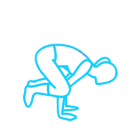
Bakasana is another wonderful Yoga pose that promotes a feeling of courage, strength and balance. Start by squatting down on your Yoga mat with your feet 4 to 6 inches apart. If you do not have the flexibility to keep your heels flat on the mat when you squat down, please use a folded blanket to create a firm and comfortable foundation for the pose.

Take a few moments and stretch out your inner groin muscle, your lower back and your upper back muscles. You can do this while you are in a squatting position by gently resting your knees against your upper arms until you feel some resistance. Play with this edge as you prepare your body to balance in Bakasana. When you are ready, inhale and the slowly exhale and tip your weight forward until you are balancing your shins on the back of your arms. Lift one or both feet off the floor as you shift your body weight more firmly onto the back of your arms. Hold for a few breaths and come down and rest in Child’s Pose. Repeat two more times for three to five breaths each.

© Copyright 2011 – Aura Wellness Center – Publications Division

To see our selection of Online Yoga teacher certification courses, please visit the following link.

http://www.aurawellnesscenter.com/store/

FREE Yoga Report. FREE Yoga Newsletter. FREE Yoga Videos. Free Podcasts. Bonus: Free Yoga e-Book, “Yoga in Practice.”

FREE CONTENT: If you are a Yoga Teacher, Yoga studio, blogger, e-zine, or website publisher, and are in need of quality content, please feel free to use my blog entries (articles). Please be sure to reprint each article, as is, including the resource box above. Namaste!

Yoga for Osteoporosis

Wednesday, September 21st, 2011

yoga teacher trainingBy Faye Martins 

According to the National Osteoporosis Association, the cost of medical care for fractures related to the disease will reach $25 billion by 2005. More prevalent in postmenopausal women and in men over 70, the disorder is associated with the loss of estrogen in females and testosterone in males. Because Yoga is a low-impact exercise that strengthens bones and balances hormones, it is one of many techniques being used in the fight against osteoporosis.

Yogic Prevention for Osteoporosis 

• Weight-bearing asanas build strong bones and strengthen muscles. All poses promote good health.

• Meditation alleviates stress-related and hormonal symptoms before and after menopause, improving mood and strengthening adrenal glands.

• Pranayama complements meditation – boosting the circulatory system, removing toxins, and carrying freshly oxygenated blood to the organs.

Ten Yoga Poses for Osteoporosis 

• Downward-Facing Dog stretches the entire body and refreshes the mind.

• Standing Forward Bend calms the nervous system and lengthens the hamstrings.

• Big Toe Pose stretches and strengthens the hamstrings.

• Bridge Pose revitalizes tired leg muscles and quiets the mind.

• Warrior II increases stamina and promotes good posture.

• Extended Triangle helps to align the body and strengthens ankles, legs, and feet.

• Extended Side Angle Poses elongates the side of the body from the heel to the lifted arm.

• Half Moon Pose strengthens bones, tones muscles, and improves mood. The Half Moon posture can be easily modified for anyone who has difficulty with balance by using a chair, wall, or the corner of a room.

• Extended Hand-to-Big-Toe Pose improves balance and lessens the likelihood of falls.

• Wheel Pose energizes the body and makes the spine, abdomen, arms, and legs stronger and more flexible.

With the use of props and proper adjustments, each of the above-mentioned postures (asanas) can be modified for any Yoga student. All of these poses also help to do the following: tone the body, increase bone density, remove toxins, release negative energy, massage organs, increase circulation, and balance the endocrine system. Maintaining good emotional and physical health helps to improve mood and prevent all kinds of illnesses.

Precautions Regarding Yoga for Osteoporosis 

Anyone with osteoporosis should consult a health care professional and an experienced Yoga instructor in order to prevent the following complications:

• People with low bone density may develop spontaneous fractures to the spine as the body returns to its normal position.

• Backbends may cause stress fractures. A suggested modification is to gently tilt the whole spine without force to avoid pressure that may occur with bending the spine back.

• Some weight bearing exercises can cause hairline fractures of the bones or spine.

For those people who want to prevent osteoporosis and have no other health issues, traditional Yoga is a good option. For anyone with bone-related issues, however, good advice and a slow pace in a gentle Yoga class are the way to go.  Yoga for osteoporosis is a viable solution and a preventative measure.

© Copyright 2011 – Aura Wellness Center – Publications Division

To see our selection of Online Yoga teacher training courses, please visit the following link.

http://www.aurawellnesscenter.com/store/

FREE Yoga Report. FREE Yoga Newsletter. FREE Yoga Videos. Free Podcasts. Bonus: Free Yoga e-Book, “Yoga in Practice.”

FREE CONTENT: If you are a Yoga Teacher, Yoga studio, blogger, e-zine, or website publisher, and are in need of quality content, please feel free to use my blog entries (articles). Please be sure to reprint each article, as is, including the resource box above. Namaste!